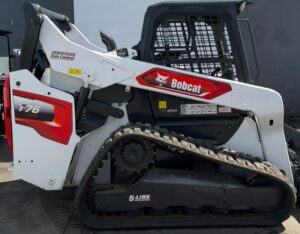

A skid steer needs quick daily checks before each shift and a full service at regular intervals, most often every 250 to 500 operating hours, plus deeper services around 1,000 hours. Exact intervals depend on the make, model and how hard the machine works, so always follow the operator’s manual. This guide shows what is usually checked at each stage, and the signs that a machine needs a mechanic.
Skid steer maintenance at a glance
| When | What to check or service |
|---|---|
| Every day (about 10 hours) | Engine oil, coolant and hydraulic oil levels; air filter indicator; tires or tracks; lights, seat belt and safety bar; grease points; leaks and loose parts |
| About every 50 hours | Grease all pivot points; check track tension or tire pressure; check battery and cables |
| About every 250 hours | Engine oil and filter on many models; fuel filter and water separator; belts; radiator and cooler cleaning; a full inspection |
| About every 500 hours | Hydraulic and hydrostatic filters on many models; air filter elements; final drive oil check |
| About every 1,000 hours | Hydraulic oil change on many models; final drive oil change; coolant test or change; valve adjustment where the manual calls for it |
These are typical intervals. Your machine’s manual has the exact hours and fluids for your model.
Daily checks before each shift
- Fluids. Check engine oil, coolant and hydraulic oil with the machine level and the boom down.
- Leaks. Look under the machine and around hoses, cylinders and the final drives.
- Air filter. Check the restriction indicator, especially on dusty sites.
- Tracks or tires. Look for cuts, missing lugs and correct tension or pressure.
- Safety. Seat belt, seat bar, lights, backup alarm and the attachment locking pins.
- Grease. Grease the loader arms, cylinders and the attachment plate as the manual indicates.
The 250-hour service
For many owners this is the main routine service, and it is the interval we recommend at least once a year for machines that work fewer hours. On many models it includes the engine oil and filter, the fuel filter, a check of belts and hoses, cleaning the radiator and oil cooler, and a full inspection. Read more about engine oil in oil changes for your Bobcat skid steer.
The 500 and 1,000-hour services
These go deeper into the hydraulic and drive systems: hydraulic filters, hydraulic oil, final drive oil and coolant. Skipping them is a common cause of expensive repairs, because dirty hydraulic oil wears pumps and motors, and low or old final drive oil damages gears and bearings.
Signs your skid steer needs a mechanic
- Slow or weak lift and tilt, or hydraulics that get hot quickly.
- Oil leaking at a final drive, or grinding noises when the machine travels.
- The machine pulls to one side.
- Hard starting, loss of power or heavy smoke.
- Warning lights or controls that stop responding.
Catching these early usually turns a major repair into a minor one.
Frequently asked questions
How often should I service my skid steer?
Do daily checks before every shift and a full service at the interval in your manual, often every 250 to 500 hours. If the machine works few hours, service it at least once a year.
How often do you grease a skid steer?
Most manufacturers call for greasing the loader arms and attachment pivots daily or every 8 to 10 hours of work, and more often in mud or sand.
Can I do skid steer maintenance myself?
Daily checks, greasing and many filter changes can be done by the owner with the manual. Hydraulic, final drive and engine repairs are best left to a mechanic with the right tools.
Need a service or repair in South Florida? Our shop in Hialeah handles skid steer service and repair for Bobcat and Caterpillar machines, at the shop or on site. Call +1 786 305 3641.