Attention Contractors and Operators! Let’s dive into the world of skid steer controls and explore the diverse options available on modern job sites. Whether you are expanding your fleet or upgrading your current machine, understanding the distinction between classic hand and foot controls, modern joysticks, and the difference between H-Pattern and ISO setups is crucial for operator efficiency.
Hand and Foot Controls: The Traditional Setup

Pros of Hand and Foot Controls:
- Familiarity: Many veteran operators started their journey with hand and foot controls, finding comfort and muscle memory in the traditional setup.
- Feedback: The tactile sensation provided by separate mechanical controls for steering and direction can offer operators a heightened sense of control and precision when digging or grading.
- Customization: Hand and foot pedals can often be tailored to individual preferences and ergonomic needs, enhancing operator comfort during long shifts.
Cons of Hand and Foot Controls:
- Learning Curve: For newcomers, mastering the coordination required to steer with hands and lift with feet can be challenging.
- Fatigue: Prolonged use of foot pedals can lead to operator fatigue, especially in applications that require constant boom and bucket adjustments.
- Limited Mobility: Operators may find themselves restricted by the physical effort required, potentially impacting productivity at the end of a long workday.
Joystick Controls: The Modern Standard

Pros of Joystick Controls:
- Intuitive Operation: Joysticks offer a streamlined interface. Younger operators, or those familiar with modern Caterpillar loaders and excavators, find this setup highly intuitive.
- Efficiency: With all controls consolidated into your hands, maneuvers are swift and seamless, drastically boosting job site productivity.
- Reduced Fatigue: The minimal physical movement (often electro-hydraulic) required to operate joysticks alleviates strain on the knees and ankles, promoting operator well-being.
Cons of Joystick Controls:
- Transition Period: Operators accustomed to pedals may require a few days to adapt to the high sensitivity of a joystick setup.
- Feedback: Because they are often electronic, joysticks may lack the raw mechanical feedback of traditional linkages.
- Complexity: Advanced systems have multiple buttons on the joystick for auxiliary hydraulics, which can initially overwhelm a novice operator.
H-Pattern vs. ISO Controls: What is the Difference?
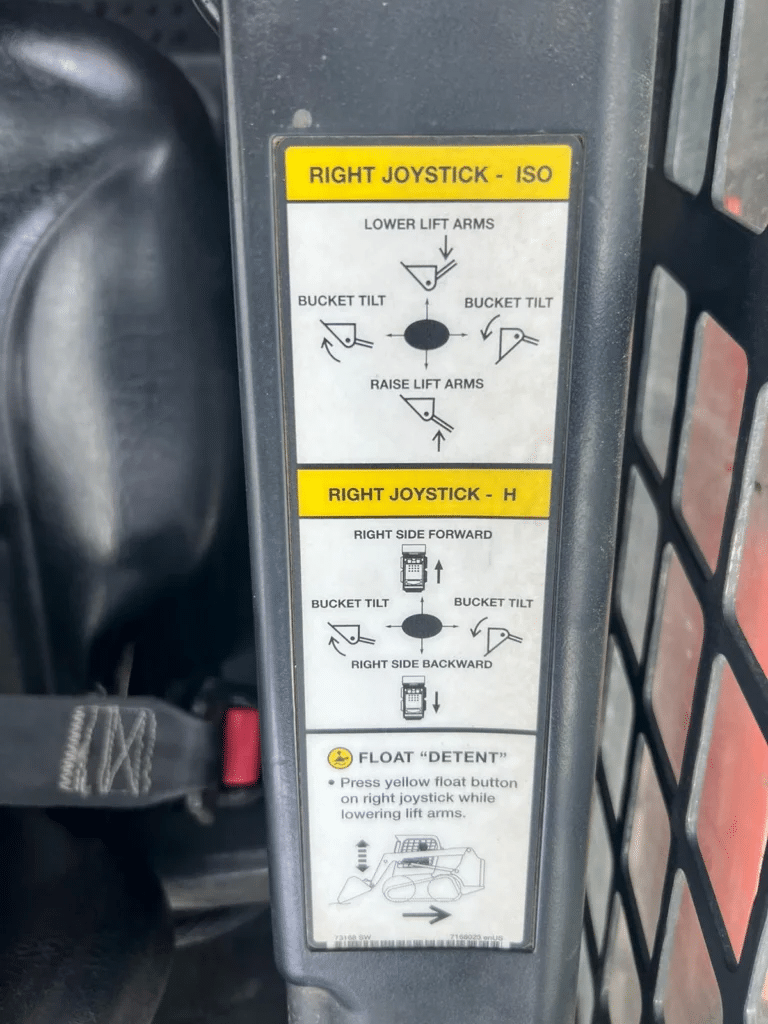
When you transition to joysticks, you will encounter two primary operating patterns. Many modern used skid steer models offer Selectable Joystick Controls (SJC), allowing you to switch between these two modes with the push of a button.
H-Pattern Controls:
- Operation: The left joystick controls the left wheels/tracks (forward and backward) and the lift arm. The right joystick controls the right wheels/tracks and the bucket tilt. It requires pushing both joysticks forward to drive straight.
- Advantages: Preferred for its straightforward feel. It mimics the drive function of traditional twin-lever controls without the foot pedals.
- Usage: Very common in North America and frequently found in older equipment.
ISO Controls:
- Operation: Based on international standards (regulated by organizations like the ISO). The left joystick entirely controls the machine’s movement (drive and steering), while the right joystick exclusively controls the loader arm and bucket functions.
- Advantages: Offers a highly standardized layout. It allows for effortless one-handed driving while the other hand focuses on load management.
- Usage: Widely adopted globally and considered the modern standard for new equipment.
Skid Steer Controls Comparison Table
Use this quick reference guide to understand how each system dictates machine movement and attachment operation:
| Feature / Function | ISO Joystick Controls | H-Pattern Joysticks | Hand & Foot Controls |
|---|---|---|---|
| Movement (Drive) | Left joystick (Forward/Back/Left/Right) | Left joystick controls left side; Right joystick controls right side | Two hand levers (Push both forward to go straight) |
| Lift Arms (Boom) | Right joystick (Forward/Backward) | Left joystick (Left/Right movement) | Dedicated left foot pedal |
| Bucket (Tilt/Curl) | Right joystick (Left/Right) | Right joystick (Left/Right movement) | Dedicated right foot pedal |
| Foot Controls Used? | No | No | Yes |
| Pros | One-handed driving; Industry standard. | Familiar drive feel for older operators. | Excellent mechanical feedback. |
Conclusion: Which Control is Right for You?
The choice between hand and foot controls, joysticks, H-Pattern, or ISO ultimately boils down to individual preference, job requirements, and what your operators are most comfortable using. Embracing the diversity of these systems ensures that every operator can work safely and efficiently.
If you are looking for a machine that fits your exact operating style, check out our Bobcat skid steer inventory. We offer units with various control setups, and our team is ready to help you secure the right machine with flexible equipment financing solutions. Happy operating!